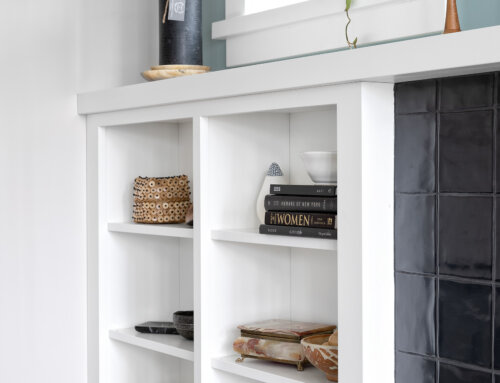


At some point, usually after a handful of thoughtful updates, a room starts to feel… unsettled. Not wrong. Not bad. Just not quite right. Which is confusing, because everything in it is perfectly nice.
Most people assume this is a matter of needing one more piece, or refining their choices slightly. It rarely is.
What’s actually happening is far less obvious, and a bit more frustrating. You’re not lacking good taste — in fact, most of my clients have very good instincts. They’re drawn to quality, to pieces with presence, to spaces that feel considered. The issue is that those instincts are being applied one decision at a time, rather than held together by a clear point of view.
And that distinction matters more than people realize.

Because a room isn’t built through a series of individual upgrades. It’s shaped by how those decisions relate to each other — in scale, in proportion, in tone, and in restraint. Without that, even beautiful things begin to compete, and the space starts to feel slightly unsettled, no matter how much has been invested.
This is something I see often in Vancouver homes, particularly older ones. They carry character, certainly, but we tend to approach them cautiously — almost as though we’re afraid to lean too far into what makes them interesting in the first place. Everything becomes a little more restrained, a little more neutral, a little more “safe.”
The result is a kind of quiet tension.
Because the home itself has a point of view — in its proportions, its light, its details — but the interiors don’t always meet it there. Instead, they sit somewhere adjacent. Perfectly nice, carefully chosen, and yet slightly disconnected from the architecture they’re meant to belong to.
It’s a very different approach from what you see in English homes, for example, where contrast is embraced, history is layered rather than erased, and rooms are allowed to feel a little more collected over time. There’s less hesitation. More confidence in letting things coexist.

Here, we often edit before we’ve even begun.
And so the room ends up hovering — not quite minimal, not quite layered, not quite modern, not quite traditional. Just somewhere in between, without a clear sense of direction.
This is usually the point where people start trying to fix the feeling with additional pieces. A chair, perhaps. A different table. Another attempt to “complete” the space. But more often than not, that only reinforces the problem, because the issue was never about what was missing.
It was about what hadn’t been decided.
The homes that feel effortless — the ones people walk into and immediately relax in — are rarely the result of perfect sourcing. They come from clarity. From having taken the time to understand how the space should function, how it wants to feel, and what genuinely belongs there before anything is brought in.

That doesn’t mean everything is new, or even particularly polished. In fact, it’s often the opposite. The most successful rooms tend to have a sense of ease to them — a balance between old and new, structure and softness, intention and restraint. Nothing is trying too hard, and nothing feels like an afterthought.
Which, in its own way, is quite disciplined.
If a space feels close but not quite resolved, it’s rarely because it needs more. More often, it needs someone to step back and make sense of what’s already there — to adjust, to edit, and occasionally to say no to something that is perfectly lovely on its own, but not right for the room.
That’s typically where I come in.
If you’re at that point — where everything is almost there, but not quite — a focused consultation can bring clarity surprisingly quickly.
You can learn more about my Design Discovery Consultation here.